



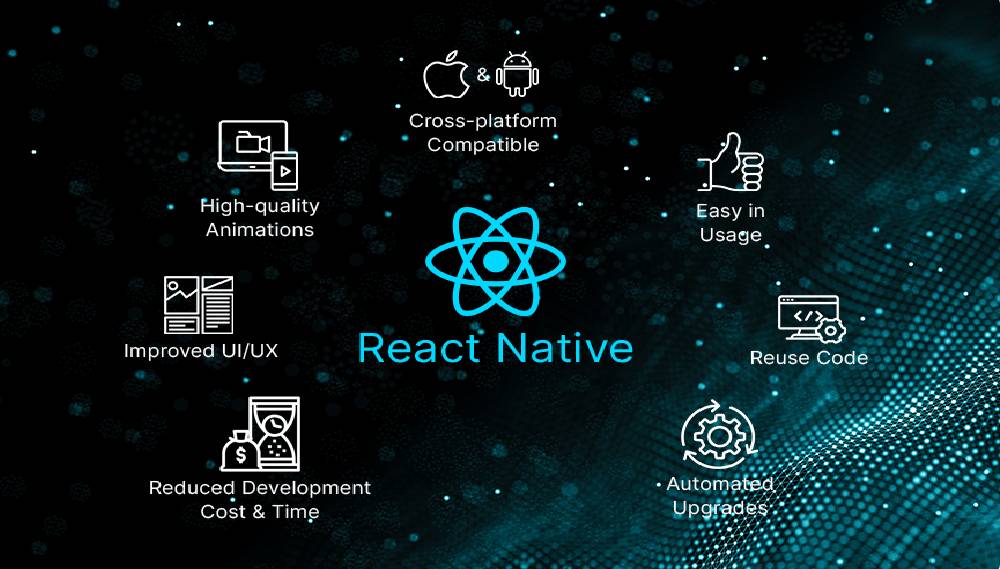
React Native is Meta's open-source framework for building cross-platform mobile applications using JavaScript and TypeScript — the same languages used in React web development. In 2026, React Native's New Architecture — consisting of JSI (JavaScript Interface), the Fabric renderer, and TurboModules — became the default for all new React Native projects, eliminating the JavaScript bridge that was the framework's primary performance bottleneck since its introduction. The result is near-native performance for standard business applications on both Android and iOS from a single JavaScript codebase. Garuda Technologies builds React Native applications for Gurugram IT companies and businesses whose development teams already have React web expertise, who need to share component logic between a web application and a mobile app, or who need access to React Native's large ecosystem of JavaScript libraries and community packages.
React Native's original architecture used a serialised JSON bridge to communicate between JavaScript code and native Android and iOS APIs. Every interaction that required native functionality — a touch event, a navigation gesture, a camera API call — crossed this bridge synchronously, creating a performance bottleneck that produced dropped frames and sluggish interactions on complex UIs. The New Architecture eliminated this bottleneck in three ways:
New Architecture Component | What It Does and Why Performance Improved |
JSI — JavaScript Interface | Replaces the serialised JSON bridge with a direct JavaScript-to-C++ interface. JSI allows JavaScript code to hold direct references to C++ objects and call methods on them synchronously without serialisation overhead. The result: native API calls that previously required serialisation round-trips now execute in nanoseconds rather than milliseconds. |
Fabric — New Rendering System | Fabric replaces the old asynchronous shadow thread rendering with a synchronous C++ rendering pipeline. UI updates are calculated on the JavaScript thread and applied to native views synchronously, eliminating the frame drop that occurred when UI updates were asynchronously processed by a separate shadow thread that could fall behind under heavy load. |
TurboModules | Lazy-loaded native modules that are initialised only when first called, rather than at application startup. A React Native app with 50 native modules previously initialised all 50 at launch — adding startup time proportional to module count. TurboModules initialise each native module on first use, dramatically reducing startup time for apps with large native module dependencies. |
React Native's primary advantage over Flutter is its JavaScript/TypeScript foundation and its direct connection to the React web ecosystem. Three scenarios make React Native the better choice:
A Gurugram IT company or SaaS product that already has a React TypeScript web development team can extend that team's capability to mobile with React Native without a full language context switch to Dart. The component mental model, TypeScript typing patterns, state management libraries (Zustand, TanStack Query), and testing tools (Jest, React Testing Library) that the web team already uses carry over directly to React Native. A React developer becomes productive in React Native within 1 to 2 weeks — compared to 3 to 6 weeks for a Dart and Flutter onboarding. For companies internalising mobile development into an existing web team, this onboarding difference is commercially significant.
React Native's architecture enables genuine code sharing between a React web application and a React Native mobile app — not just conceptual similarity but actual reusable modules. Business logic, API integration code, data transformation functions, and TypeScript type definitions written for the web application can be imported directly into the React Native project. For Gurugram SaaS companies building a mobile companion app alongside their web product, this code sharing reduces total development effort compared to Flutter, which requires rewriting shared logic in Dart even if an equivalent JavaScript version exists.
React Native has direct access to the npm ecosystem — the largest package repository in software development with over 2.1 million packages. Third-party JavaScript libraries for analytics, feature flagging, A/B testing, customer support, and marketing tools that publish React Native SDKs are typically available for React Native before they publish Flutter equivalents. For applications requiring deep integration with marketing technology stacks — Segment, Amplitude, Branch, Intercom — React Native's JavaScript ecosystem access is a practical advantage.
Stack Component | Technology and Standard |
Language | TypeScript. Strict TypeScript configuration enforcing null safety, type-safe component props, and typed API response models. React Native without TypeScript is not offered — the type safety benefit for a cross-platform application that must behave correctly on both Android and iOS is too significant to omit. |
Architecture | New Architecture (JSI, Fabric, TurboModules) as the default for all new projects since 2024. Component-based architecture following React patterns. TanStack Query for server state management and API caching. Zustand for client-side global state. |
Navigation | React Navigation 7 for stack, tab, and drawer navigation with type-safe route parameters. Deep linking configuration for both Android and iOS included in all projects. |
Styling | StyleSheet API for performant styles. NativeWind (Tailwind CSS for React Native) for utility-first styling familiar to web React developers. React Native Paper or React Native Elements for pre-built UI component libraries where design customisation is not required. |
Testing | Jest with React Native Testing Library for unit and component tests. Detox for end-to-end testing on physical devices and simulators. Minimum 60 percent test coverage on business logic. |
CI/CD | GitHub Actions with Fastlane for automated build, test, and Play Store / App Store deployment pipelines. Automated Detox E2E tests run on every pull request before merge. |
Project Type | India Pricing Range and Timeline (2026) |
Simple cross-platform app (5-12 screens) | INR 3,00,000 to INR 7,50,000. New Architecture React Native, TypeScript, REST API, push notifications, both stores. 8 to 14 weeks. |
Mid-complexity business app (12-25 screens) | INR 7,50,000 to INR 20,00,000. Authentication, complex UI, payments, offline, code sharing with React web app. 14 to 22 weeks. |
Complex React Native platform | INR 18,00,000 to INR 45,00,000. Real-time features, extensive JavaScript library integrations, shared web codebase, custom native modules. 20 to 36 weeks. |
React Native remains fully relevant in 2026 and is not being replaced by Flutter. Both frameworks collectively power over 80 percent of the cross-platform mobile development market. React Native's New Architecture eliminated its historical performance disadvantage relative to Flutter for standard business applications. Flutter has a slight edge in pure UI rendering performance and visual consistency, while React Native has an advantage in JavaScript ecosystem access and team onboarding speed for existing React developers. The choice between them in 2026 is a team and project fit decision — not a decision about which framework is technically superior.
Yes, meaningfully. Business logic, TypeScript type definitions, API integration modules, data transformation functions, and utility code written in plain TypeScript can be shared between a React web application and a React Native mobile app in a monorepo structure (using tools like Turborepo or Nx). UI components cannot be shared directly — React Native uses mobile-specific components (View, Text, TouchableOpacity) rather than HTML elements (div, p, button) — but the component logic, state management, and data layer can be shared. For Gurugram SaaS companies and IT service businesses with existing React TypeScript web codebases, this code sharing reduces total mobile development effort by 15 to 25 percent compared to starting a Flutter app from scratch.
React is a JavaScript library for building user interfaces in web browsers using HTML elements (div, span, input). React Native uses the same React component model and JSX syntax but renders to native Android and iOS UI components (View, Text, ScrollView, TextInput) rather than HTML elements. The programming model, TypeScript typing, hooks, state management patterns, and component architecture are identical — the difference is in the rendering target. A React web developer learns React Native by replacing HTML elements with React Native equivalents and learning mobile-specific concepts (navigation patterns, platform permissions, device API access). Most React developers become productive in React Native within 1 to 2 weeks of focused learning.

Garuda Technologies - Copyright . All rights reserved.
Garuda Technologies is a Gurgaon-headquartered technology and travel services company operating from Udyog Vihar, Sector 19 — the heart of Gurugram's IT and industrial corridor. Founded with the conviction that businesses deserve a single accountable partner for their digital and travel needs, Garuda Technologies operates two integrated verticals: a full-spectrum IT and digital services division, and a travel services division powered by seven specialized travel brands.